On the line, annealing isn’t a nice-to-have—it’s your last clean shot to pull thermal stress out before the glass ships. With fiber glass, the margin is thinner. It cools fast, sure, but uneven cooling hides stress that shows up later as spontaneous breakage. If your heater can’t hold a stable, uniform thermal field with tight control, you pay for it in scrap, rework, and lost throughput. We built our fiber glass annealing heater on short-wave infrared for one simple reason: it puts heat where it needs to be—straight into the product—without leaning on air to carry it. The payoff is a repeatable temperature profile across the glass, faster recovery after door openings, and control that holds setpoint in a tight band.
What matters under the hood: infrared gives predictable heat
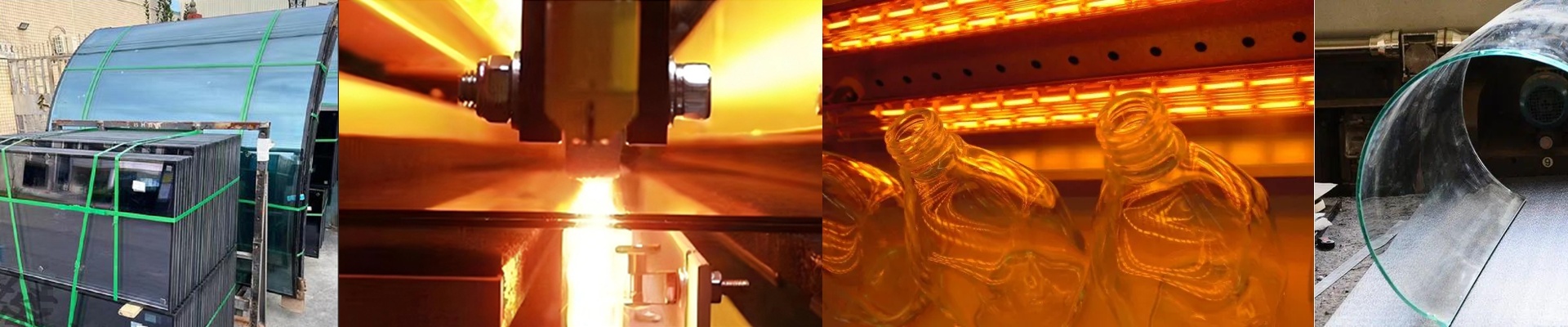
Infrared and convection just don’t behave the same way. Convection heats air, and the air heats the glass. Infrared delivers energy by radiation, so the surface absorbs heat immediately, with far less sensitivity to airflow patterns and ambient swings. For fiber glass annealing, we run short-wave infrared emitters with high intensity and a fast response. In practice, that means the heater hits stable operating temperature quickly and reacts the moment setpoint changes, cutting down time spent at the wrong temperature. The emitters are laid out to create a uniform thermal field across the load, so you don’t get hot spots or cold edges that drive warp and stress. The engineering points that turn into stable output on the floor:
- Uniform thermal field: Emitter layout and reflector geometry are matched to the annealing zone, minimizing temperature variation across the glass.
- Rapid response: Short-wave infrared heats and cools fast, which sharpens control during changeovers and interruptions.
- Directional radiation: Energy goes where it’s needed, wasting less heat and keeping excess energy out of the surrounding environment. None of this is theoretical. What you see is fewer scrapped parts from thermal shock, less temperature drift, and annealing that behaves the same shift after shift.
Why this works where it has to: annealing fiber glass in a real plant
Fiber glass annealing sits between forming and downstream processing—often right before coating, lamination, or final inspection. The area is tight, fast, and doesn’t forgive weak links. When the heater misses, you know it fast. Temperature nonuniformity shows up as uneven curing, edge curl, and stress fractures. Slow response drags cycle time, and every extra minute adds cost across the whole line. Our infrared annealing heater hits those pressures head-on:
- Stress removal you can count on: A stable, uniform thermal profile lets you cool through the critical range in a controlled way, reducing residual stress that causes field failures.
- Throughput that keeps up: Fast response and quick recovery mean less waiting for the zone to come back to setpoint after loading or a pause. That keeps takt steady.
- Energy use that isn’t wasteful: Directional radiation heats the product, not the air. In a lot of plants, that translates to lower energy per unit processed compared to convection-heavy systems.
- Hardware built for the floor: Emitter design and support components are specced for industrial duty cycles, not lab-only duty. We also design the heater to fit real lines. If you’re running a standard annealing line, we can deliver a module that integrates into your existing control logic and mechanical envelope. For retrofits, the goal is drop-in compatibility—same mounting footprint, same interfaces, and performance you can predict.
What to watch: installation, compatibility, and operating limits
Industrial heating equipment runs best when everyone is on the same page.
- Clearances matter: Infrared relies on line-of-sight radiation. Keep the recommended clearance from obstacles and maintain the specified distance to the glass. Blocked sightlines and forced drafts will create uneven heating.
- Control tuning sets the quality: Infrared reacts quickly, so your PID settings, ramp rates, and dwell times need to match the product. If you’re running thicker or thermally sensitive fiber glass, tune conservatively to avoid thermal shock.
- Emitters wear out: Industrial emitters lose output over time. Plan maintenance windows and keep spares on hand. Pushing emitters past end-of-life shows up as drift, longer recovery, and inconsistent annealing.
- Zones aren’t interchangeable: If your line has multiple heating zones, the infrared module has to be matched to each zone’s load profile. One-size-fits-all rarely delivers repeatable stress removal. If you’re upgrading an existing line or specifying a new annealing section, start with your load profile: glass thickness, line speed, maximum temperature, and the required cooling curve. We’ll size the heater, define the emitter layout, and provide control guidance so it performs from day one. On the plant floor, annealing is where quality gets locked in. The right infrared heater gives you control, repeatability, and uptime—without adding complexity. If your annealing zone is wrestling with temperature swings and slow recovery, run a test section and measure the difference for yourself.